Risk Management
Purpose
RPD manages WHS risk on every job — finding the hazards, rating the risk, putting controls in place, and checking those controls hold as the work proceeds. This single procedure replaces RPD's earlier WHS Risk Management Policy and Procedure.
Risk is assessed before work starts and re-checked whenever the job changes: when site conditions shift, a hazard or incident is reported, a SWMS no longer matches the work in front of the team, or an audit finding or corrective action shows a control is not working.
Procedure
| Field | Requirement |
|---|---|
| Applies when | RPD plans or performs remedial, painting, facade, waterproofing, demolition, breakout, access, plant, hazardous substance, live services, lead paint, silica, asbestos unexpected finds, manual handling, lone work or public/resident interface work. |
| Owner | Project Manager before work starts. Site Supervisor during the work. Workers and subcontractors must follow controls and report hazards. |
| Before work starts | Complete the project risk assessment, review scope, site conditions, legal/client requirements, design risks, access, services, hazardous materials, public/resident interface, plant, competence and SWMS requirements. |
| Minimum controls | Identify hazards, assess risk, apply the hierarchy of controls, prepare or review SWMS for high-risk construction work, brief workers, record required permits, confirm competencies and monitor controls. |
| Hold point | Do not start or continue work where the SWMS does not match the task, controls are missing, design risk is unresolved, required permits are not approved, services are not identified, or hazardous materials are suspected and not assessed. |
| Breadcrumb function | Project Risk Assessment, Hazard Reports, SWMS review/approval, permits, site alerts, toolbox talks, inspection actions and corrective-action task tracking. |
| Stop / escalate | Stop work and escalate to the Site Supervisor or Project Manager when conditions change, a high-risk hazard is uncontrolled, a worker raises a serious concern, a notifiable incident occurs, or corrective actions are overdue. Formal findings, repeat issues and non-conformances are escalated into PIMS. |
Risk Assessment Model
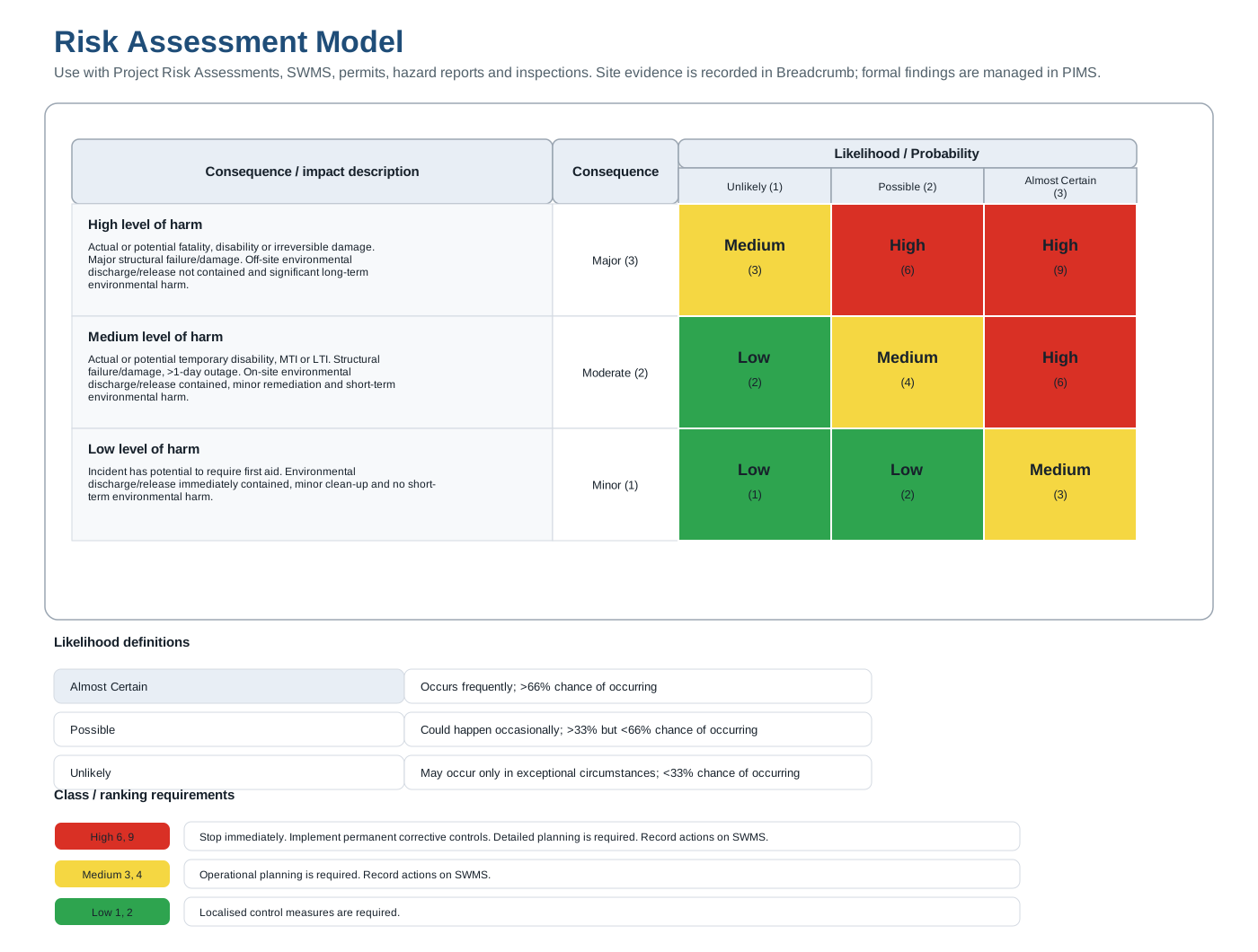
RPD rates each hazard against the model below, which sets how much planning and control a task needs before it can go ahead.
| Step | Action | Output |
|---|---|---|
| 1. Identify the hazard | Look for anything that can harm workers, subcontractors, residents, visitors or the public. | Hazard recorded in the project risk assessment, SWMS, inspection, hazard report or Site Alert. |
| 2. Assess the risk | Consider what could happen, who could be harmed, how serious the harm could be and how likely it is. | Risk level and priority for action. |
| 3. Select controls | Apply the hierarchy of controls and choose controls that match the task and site conditions. | Controls documented in SWMS, permit, project risk assessment, toolbox talk or site instruction. |
| 4. Implement controls | Put the controls in place before work starts and brief the people doing the work. | Workers understand the method, hold points and stop-work triggers. |
| 5. Review controls | Check controls through supervision, inspections, hazard reports, incident reviews, worker feedback, audits and management review. | Controls are confirmed, changed or escalated. |
Hierarchy of Controls
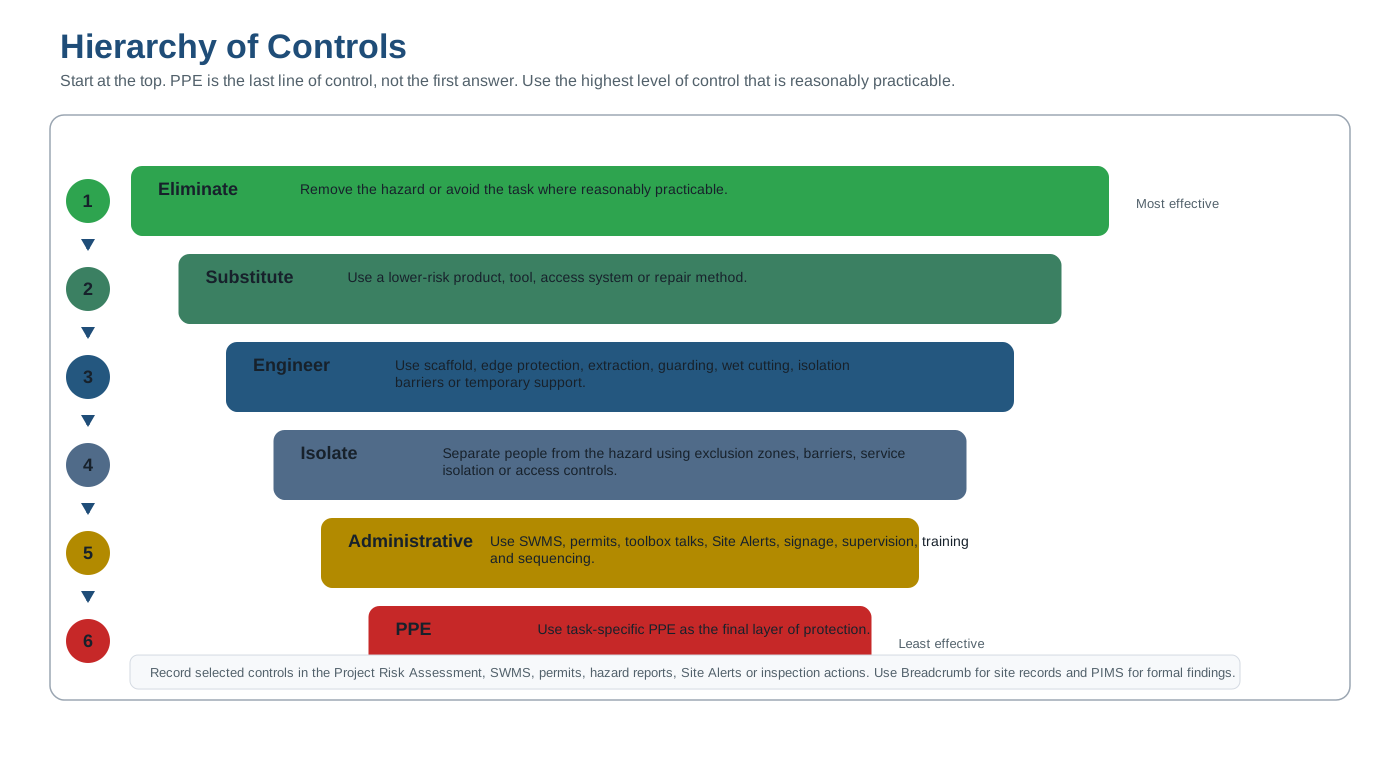
RPD applies the hierarchy of controls before relying on PPE.
| Control level | RPD example |
|---|---|
| Eliminate | Avoid a task where possible, remove unnecessary work at height, isolate a hazardous area from the work scope or change sequencing to remove exposure. |
| Substitute | Use a lower-risk product, method, tool, access system or repair approach where it achieves the same outcome safely. |
| Engineer | Use scaffold, edge protection, mechanical ventilation, dust extraction, wet cutting, guarding, temporary support, isolation barriers or engineered anchors. |
| Isolate | Set exclusion zones, separate residents/public from the work area, isolate services, close access routes or physically separate incompatible tasks. |
| Administrative | Use SWMS, permits, toolbox talks, site alerts, signage, supervision, inspection checklists, training, rotation and sequencing controls. |
| PPE | Use task-specific PPE such as respirators, eye protection, gloves, hearing protection, fall-arrest equipment and protective clothing. PPE is the last line of control. |
RPD High-Risk Work Controls
The manual keeps the high-risk controls short. The detailed, worker-facing guidance for each activity lives in RPD's high-risk construction work (HRCW) risk guides, which feed the quick guides, toolbox talks, worker cards and visual field references used on site.
| Work area | Minimum risk controls |
|---|---|
| Work at height | Confirm access method, edge protection, scaffold/EWP suitability, anchor points, exclusion zones, rescue arrangements and weather limits before work starts. |
| Scaffolds, EWPs and ladders | Check competent erection/operation, inspection tags, ground conditions, exclusion zones, licences where required and task suitability. |
| Silica | Use wet methods or on-tool extraction, no dry cutting or dry sweeping, respiratory protection where required, exclusion zones, cleanup controls and worker briefing. |
| Lead paint | Identify likely lead paint, control dust and flakes, prevent ingestion/inhalation, use suitable PPE and hygiene controls, and manage waste. |
| Asbestos unexpected finds | Stop work, isolate the area, prevent disturbance, notify the Site Supervisor/Project Manager and arrange competent assessment before work continues. |
| Demolition and breakout | Confirm structural limits, services, dust, noise, falling objects, exclusion zones, waste handling, sequencing and temporary support needs. |
| Hazardous manual tasks | Plan lifts, reduce handling, use mechanical aids, team lifts, staged deliveries and task rotation where needed. |
| Live services and isolation | Identify services, obtain permits or isolations where required, lockout/tagout plant and services, and verify isolation before work starts. |
| Excavation or ground disturbance | Confirm underground services, ground conditions, access, spoil placement, edge protection and emergency arrangements. |
| Live traffic and public interface | Use traffic/pedestrian controls, barriers, signage, spotters where needed and resident/building communication. |
| Lone work | Avoid lone work for high-risk tasks. Where lone work is approved, confirm communication, check-in arrangements, emergency access and escalation triggers. |
| Plant and powered tools | Confirm plant suitability, pre-start checks, guarding, electrical safety, maintenance status, operator competence and exclusion zones. |
Hazard Reporting
Workers, subcontractors and service providers must report hazards when they identify unsafe conditions, changed site conditions, missing controls, damaged equipment, unsafe behaviour or work that cannot be completed as described in the SWMS.
Hazards are recorded in Breadcrumb. The Site Supervisor assigns actions, confirms close-out and escalates unresolved or high-risk hazards to the Project Manager. Repeat hazards, serious hazards, overdue actions or non-conformances are escalated into PIMS.
Hazard Report forms and completed Hazard Reports are managed in Breadcrumb. Any appendix form is a reference only and does not replace the live Breadcrumb record.
Risk Register and Project Risk Assessment
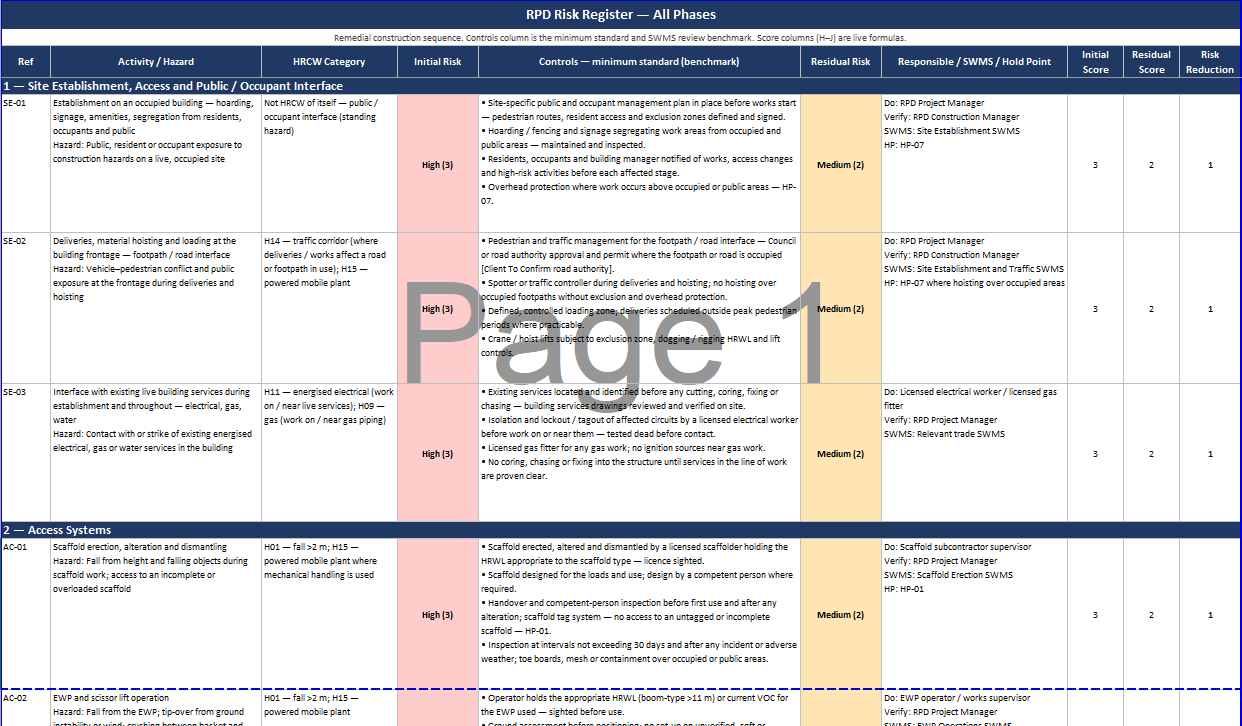
The WHS Risk Register is retained in the appendix or nominated register location. It identifies common RPD hazards and expected controls.
Project Risk Assessments are managed in Breadcrumb. They must be completed before work starts and reviewed when:
- Scope changes
- Site conditions change
- Design or sequencing changes
- New hazards are identified
- An incident, near miss or notifiable incident occurs
- A SWMS is changed
- An inspection, audit or PIMS finding requires review.
Records and Evidence
| Record | System / location | Evidence required |
|---|---|---|
| WHS Risk Register | Appendix / nominated register location | Common RPD hazards, risk controls and review evidence. |
| Project Risk Assessment | Breadcrumb | Project hazards, risk assessment, controls, review dates and responsible person. |
| SWMS | Breadcrumb | SWMS review/approval, worker briefing, task controls and amendments. |
| Hazard Report | Breadcrumb | Hazard details, risk level, assigned actions, close-out and verification. |
| Permits | Breadcrumb / project file | Approved permit, conditions, hold points and close-out where required. |
| Site inspections | Breadcrumb / PIMS where audit-related | Findings, corrective actions, responsible person and close-out evidence. |
| Formal findings and non-conformances | PIMS | Root cause, corrective action, due date, close-out and effectiveness check where required. |
Quick Guide
| Step | What RPD checks |
|---|---|
| 1. Know the work | Check the scope, location, client requirements, design risks, access, services, materials and who may be affected. |
| 2. Identify hazards | Look for hazards before work starts and as conditions change. Record them in Breadcrumb. |
| 3. Assess the risk | Decide what could happen, how serious it could be and how urgently controls are needed. |
| 4. Use the hierarchy | Eliminate risk where possible. If not, use substitution, engineering, isolation, administrative controls and PPE. |
| 5. Match the SWMS | Confirm the SWMS matches the actual task, site conditions and controls. Stop if it does not. |
| 6. Brief the workers | Use site inductions, pre-starts, toolbox talks, permits and site alerts to explain the controls. |
| 7. Monitor and review | Check controls through supervision, inspections, hazard reports, incident reviews, worker feedback and audits. |
| 8. Escalate properly | Keep site-level actions in Breadcrumb. Escalate repeat, serious or overdue issues into PIMS. |
RPD Risk Register
The WHS Risk Register identifies common RPD hazards across the remedial construction sequence, with the minimum-standard controls, responsible roles, SWMS and hold points, and the initial and residual risk scores. It is retained in the appendix or nominated register location.