System Structure and Governance
Purpose
Robertson's Remedial and Painting Pty Ltd runs its WHS system across three deliberately separate parts: the manual, Breadcrumb and PIMS. Splitting them keeps the manual short, holds the live site records in the site system, and keeps the assurance records in the review system.
The manual sets the rules. Breadcrumb and PIMS hold the records used to check the rules were followed.
Common Terms
| Term | Meaning |
|---|---|
| WHS Manual | This document. The corporate WHS rules, governance, duties, approval pathways and evidence requirements that apply across all RPD work. |
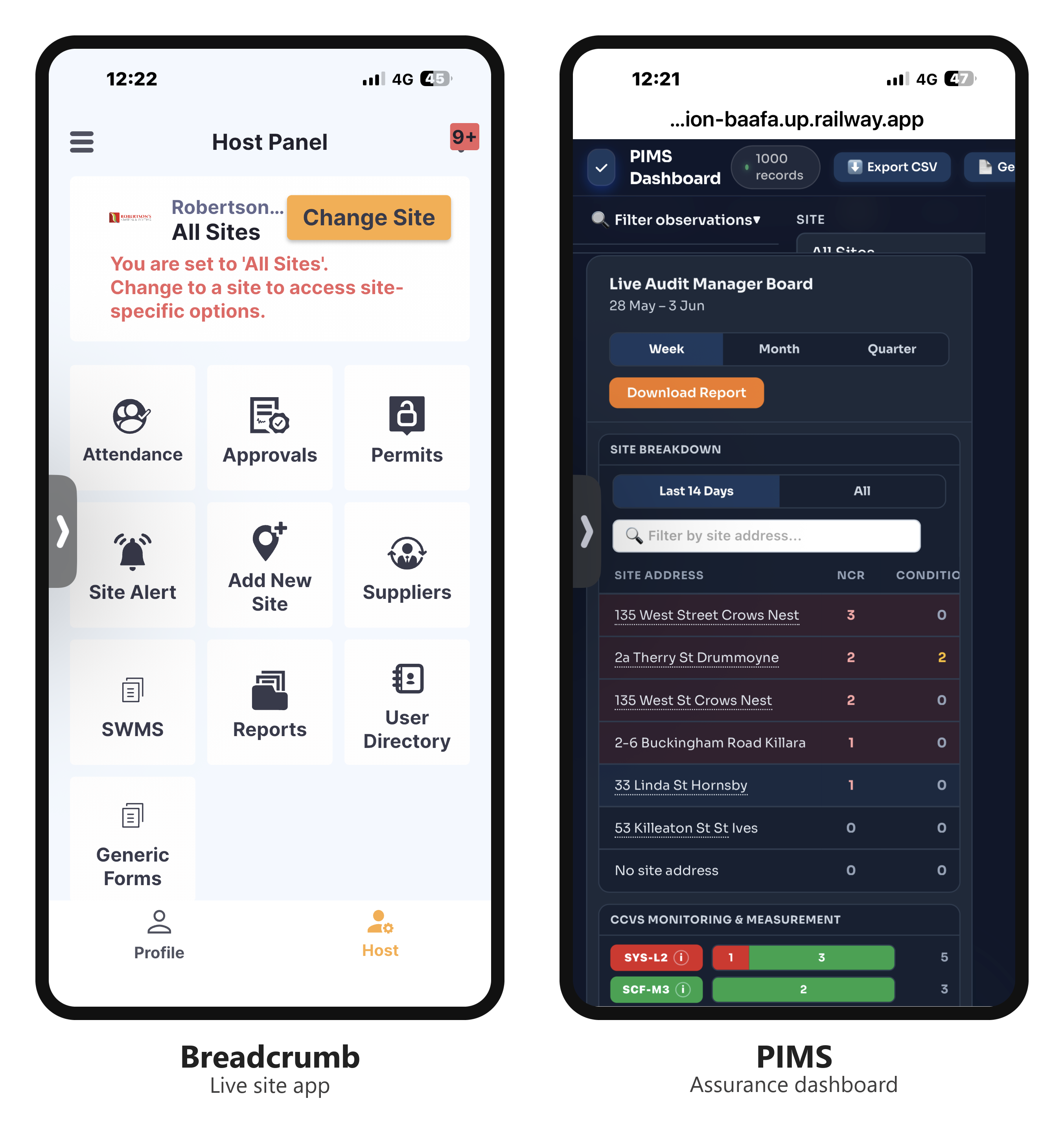
| Breadcrumb | RPD's live site administration system. Holds inductions, licences/tickets/competencies, working hours and timecards, SWMS/SSMP/RAMS, SDS, insurances and certificates of currency, permits to work, pre-starts and toolbox talks, site communications and alerts, plant and operator inductions, plant service registers, hazard reports, incident reports and site inspections. |
| PIMS | RPD's assurance and review system. Holds internal audits, findings, formal corrective actions, non-conformances, root cause records, effectiveness checks, KPIs, LTIFR, trends, reporting and management review evidence. |
| SSMP | Site Safety Management Plan. The project-specific plan prepared by the Project Manager before work starts on a site. It sets out the project hazards, controls, hold points, permits, emergency arrangements and reporting rules for that site. The WHS Manual sets the rules; the SSMP applies them on a project. |
| SWMS | Safe Work Method Statement. The document that sets out how high-risk construction work is carried out safely — the hazards, the control measures and how they are implemented and monitored. |
| RAMS | Risk Assessment and Method Statement. A combined risk-assessment and method document some service providers supply in place of a SWMS; RPD accepts it where it covers the relevant high-risk construction work and the required controls. |
| VOC | Verification of Competency. A practical check confirming a worker is currently competent to operate specified plant or equipment, in addition to any high-risk work licence. |
Breadcrumb and PIMS are both used on a phone in the field. Breadcrumb is the live site app workers and supervisors use day to day; PIMS is the assurance dashboard management uses to review performance.
Robertson's Remedial and Painting Pty Ltd Details
Robertson's Remedial and Painting Pty Ltd performs remedial and painting works for residential, strata and commercial clients. Typical work includes painting, render repair, demolition, concrete breakout, waterproofing, tiling, facade replacement and weatherproofing, plant and powered tool use, work at height and work around occupied buildings.
Primary WHS hazards include falls, falling objects, silica dust, lead paint, asbestos unexpected finds, plant and electrical risks, manual handling, public and resident interface, hazardous substances and emergency access constraints.
Controls must be project-specific. Workers are required to stop work where controls are missing, conditions change, or the work cannot be completed as described in the SWMS.
Legal and Other Requirements
Robertson's Remedial and Painting Pty Ltd identifies, maintains and reviews the WHS legal and other requirements that apply to its work. This includes the WHS Act 2011, WHS Regulation 2017, applicable SafeWork NSW Codes of Practice, client requirements, Australian Standards and relevant contractual requirements.
Senior Management is responsible for maintaining the legal register and confirming it remains current.
RPD maintains a legal register for WHS laws, Codes of Practice, standards, client requirements and contract requirements that apply to its work.
Estimators consider WHS legal, client and site requirements when pricing and scoping work, including access, work at height, hazardous materials, temporary works, permits, supervision, subcontractor requirements and evidence needed for the project.
Before work starts, the Project Manager checks the project scope against relevant requirements, including construction work, demolition/breakout, work at height, hazardous substances, silica, lead paint, asbestos unexpected finds, electrical risks, plant, manual handling, first aid, emergency management and contractor coordination.
Relevant WHS information is communicated through inductions, SWMS, toolbox talks, Breadcrumb records and project briefings.
Senior Management reviews legal and other requirements through audits, incident reviews, corrective actions and management review. Any breach or suspected breach must be reported, recorded and investigated.
Further detail is maintained in the legal register.
Internal and External WHS Issues
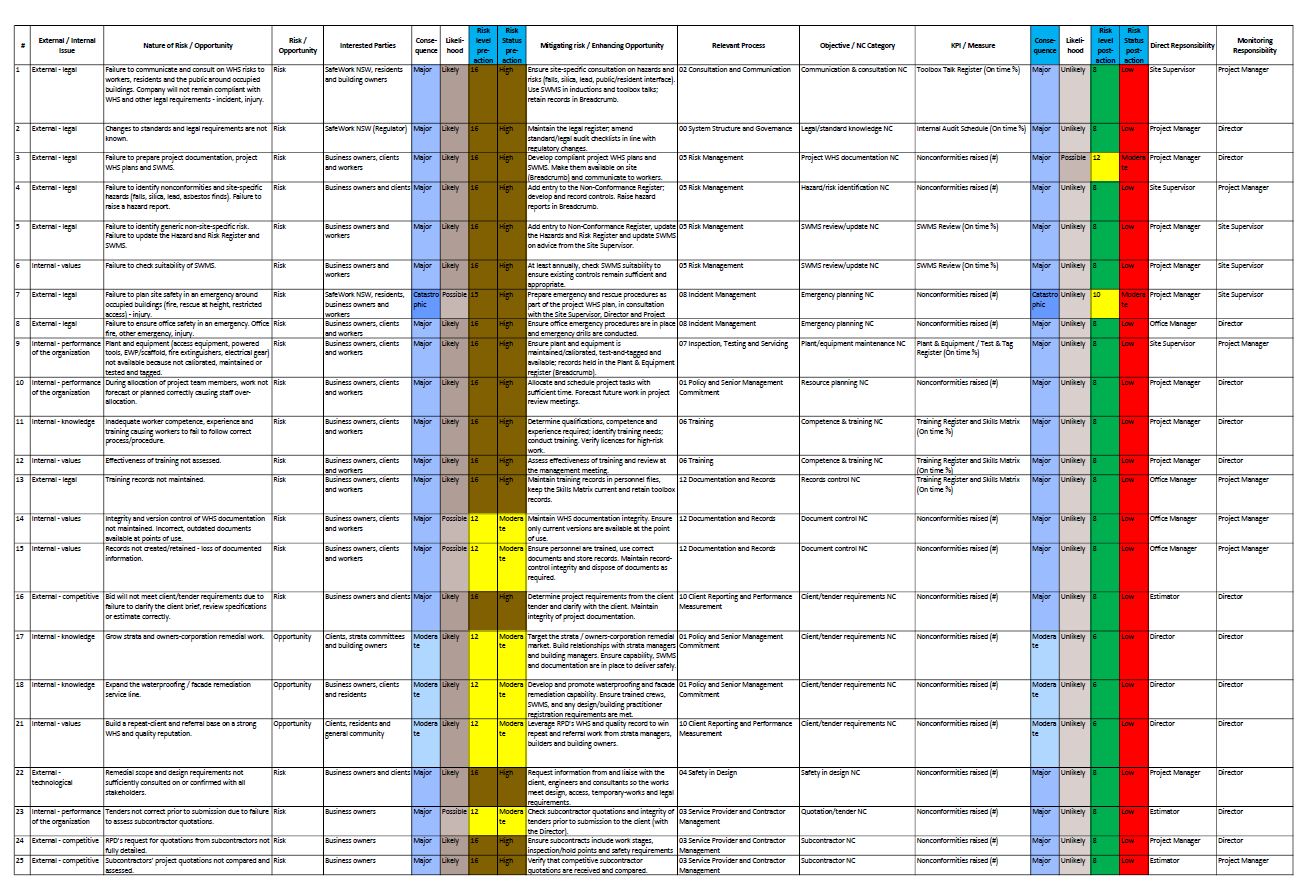
RPD identifies and reviews internal and external WHS issues that may affect the WHS system. These issues include the type of work undertaken, client and resident expectations, subcontractor capability, regulatory change, site access constraints, workforce competence, high-risk construction work and the need to maintain evidence across Breadcrumb, PIMS and project files.
Internal and external WHS issues are reviewed through management meetings, internal audits, PIMS reviews and management review. These issues, the interested parties they affect and the resulting actions are recorded and tracked in the RPD Business Planning Register, which is retained in the appendix or nominated project record location.
How the System Works
| System | Role | What it holds | Use |
|---|---|---|---|
| WHS Manual | Governance and decision rules | Duties, policy intent, contractor assessment rules, safe design decisions, return-to-work, escalation, management review and evidence requirements. | The manual sets the rule; site teams log the day-to-day evidence in Breadcrumb, and management tracks audits, findings and corrective actions in PIMS. |
| Breadcrumb | Day-to-day administration and site compliance | Hazards and incidents, inductions, training records, SWMS and site safety rules, plant/equipment, SDS, toolbox talks, worker communication, permits and initial corrective action tracking. | Site Supervisors, Project Managers and workers use it as the live site record. |
| PIMS | Monitoring, measurement and assurance | Internal audits, findings, formal corrective actions, non-conformances, root cause and effectiveness checks, KPIs, LTIFR, trends, monthly/quarterly reporting and management review data. | RPD management use it to see patterns, verify implementation and close higher-level actions. |
Governance Flow
flowchart TD
    A["WHS Manual<br/>sets the rule"] --> B["Breadcrumb<br/>records site activity"]
    B --> C["PIMS<br/>tests performance and tracks formal actions"]
    C --> D["Management Review<br/>checks whether the system is working"]
    D --> A
Governance Rules
| Question | Meaning |
|---|---|
| Who is accountable? | The Director, Project Manager, Site Supervisor, workers, contractors and PIMS reviewer each have WHS responsibilities according to their role and level of control. The WHS-appointed person is the role (held by RPD management) responsible for running the assurance system in PIMS — the internal audit schedule, findings, corrective actions and management-review records referenced in Sections 10–12. |
| Who can approve the decision? | Management decisions are required for contractor approval, safe design/design risk, permits, high-risk work methods, return-to-work arrangements, reporting frequency and formal non-conformances. |
| What must be checked before work starts? | Design risks, access, temporary works, repair sequencing, anchors, waterproofing details, facade methodology, licences, insurances, SWMS, competence, site induction, legal requirements, plant and site risks must be checked before work starts. |
| When must work stop or escalate? | Work must stop or escalate when design risk is unclear, required controls are missing, a contractor has not been accepted, unsafe conditions change the SWMS, repeat breaches occur, high-risk non-compliance occurs, or corrective actions are overdue. |
| Where is the evidence kept? | Day-to-day WHS evidence is kept in Breadcrumb. Audit results, trends, KPIs, formal findings, non-conformances and management review data are kept in PIMS. Other supporting evidence may be kept in an appendix, legal register or project file. |
| How does management know the system is working? | Management reviews WHS performance through Breadcrumb records, PIMS audit results, incident data, corrective actions, non-conformances, KPIs, trends, return-to-work records and monthly or quarterly reporting. |
| What is the evidence rule? | If a WHS decision, action or control is not recorded in Breadcrumb, PIMS, an appendix or the project file, it is not treated as verified evidence. |
WHS Manual Implementation Rhythm
| Timeframe | Action | Primary record location | What must happen |
|---|---|---|---|
| Prior to commencement | Project risk assessment | Breadcrumb / project file | Complete the project risk assessment before work starts and update it when the scope, site conditions or sequencing changes. |
| Prior to commencement | SSMP / site induction | Breadcrumb | Workers, subcontractors and visitors complete the relevant site induction before commencing work. |
| Prior to commencement | Service provider review and pre-qualification | Breadcrumb | Confirm provider approval, insurances, licences, SWMS, competencies and access requirements before the provider starts. Escalate poor performance issues into PIMS where required. |
| Weekly | Toolbox talks / safety meetings | Breadcrumb | Record attendance, topics discussed, worker feedback and agreed actions. |
| Monthly | Site safety inspection | Breadcrumb / PIMS where audit-related | Complete site inspections for longer projects, record findings and track corrective actions. |
| Monthly | Worker safety performance review | Breadcrumb | Record worker and service provider observations, spot checks, actions and close-out. |
| Quarterly | Electrical testing and tagging | Breadcrumb / plant-equipment register | Engage a competent person to test and tag electrical equipment and update the relevant register. |
| Biannually | First aid kit inspection | Breadcrumb / inspection record | Inspect kits, replace missing or expired items and retain evidence. |
| Biannually | Fire extinguisher and firefighting equipment check | Breadcrumb / inspection record | Arrange competent inspection and testing where required and retain records. |
| Every 5 years from SDS issue date | SDS review | Breadcrumb / hazardous substances register | Obtain updated SDS from suppliers and update the hazardous substances register. |
| As required | Incident reporting | Breadcrumb / PIMS for formal findings | Record incidents, injuries and near misses. Escalate notifiable incidents and formal corrective actions as required. |
| As required | Return-to-work plans | Project file / PIMS where monitored | Document suitable duties and restrictions for injured workers and review until the worker returns to pre-injury duties or the plan changes. |
| As required | Hazard reporting | Breadcrumb | Record medium to high-risk hazards, assign actions and verify close-out. |
| Ongoing | Corrective actions and non-conformances | Breadcrumb / PIMS | Track site-level actions in Breadcrumb. Escalate repeat breaches, high-risk non-compliance or overdue actions into PIMS. |
| Ongoing | Permits to work | Breadcrumb / project file | Issue permits for designated high-risk activities and retain evidence of approval and close-out. |
| Ongoing | Registers and records | Breadcrumb / PIMS / appendix / project file | Keep live records in the nominated system rather than duplicating forms inside the manual. |
Records and Evidence
| Record | System / location | Evidence required |
|---|---|---|
| WHS Manual | Master Markdown / final DOCX or PDF export | Current approved governance rules and section procedures. |
| Legal register | Appendix / nominated legal register location | Applicable WHS legislation, Codes of Practice, standards, client requirements and review evidence. |
| Internal and external issues register | Appendix / project file | Current issues, risks, opportunities and review outcomes. |
| Breadcrumb records | Breadcrumb | Hazards, incidents, inductions, SWMS, site rules, plant/equipment, SDS, toolbox talks, permits and initial corrective actions. |
| PIMS records | PIMS | Audits, findings, formal corrective actions, non-conformances, KPIs, trends, reports and management review data. |
| Project records | Project file | Contract requirements, design information, client communications, project-specific risk evidence and retained supporting records. |
Quick Guide
| Step | What RPD checks |
|---|---|
| 1. Use the manual for rules | Check the WHS Manual for duties, authority, governance rules, escalation and evidence requirements. |
| 2. Use Breadcrumb for site work | Record day-to-day hazards, incidents, inductions, SWMS, toolbox talks, permits, plant/equipment and initial actions in Breadcrumb. |
| 3. Use PIMS for assurance | Record audits, formal findings, non-conformances, root cause, effectiveness checks, KPIs, trends and management review data in PIMS. |
| 4. Check legal and client requirements | Confirm applicable legal, Code of Practice, standard, contract and client requirements before work starts. |
| 5. Stop where controls are missing | Stop or escalate work where design risk is unclear, controls are missing, conditions change, or work cannot follow the SWMS. |
| 6. Keep evidence in the right place | If it is not recorded in Breadcrumb, PIMS, an appendix or the project file, it is not treated as verified evidence. |